EN
EN

the-hidden-energy-costs-of-valencia-why-solar-alone-may-not-be-enough-for-your-microgrid, the-hidden-energy-costs-of-valencia-why-solar-alone-may-not-be-enough-for-your-microgrid, /solutions
EN

An Integrated Solar, Wind, Battery, CHP Generator and EMS Solution for Industrial and Residential Applications
Valencia has strong solar potential, but a practical microgrid must also address evening demand, electricity-price variation, limited wind resources, heating and hot-water needs, grid interruptions and residential noise constraints. An integrated system combining solar PV, battery storage, wind, CHP diesel generation, the public grid and an Energy Management System (EMS) can balance these needs.
The real challenge is not simply how much renewable energy a site can generate. It is whether generation matches the timing, cost and type of demand. A system can produce enough energy over a year and still struggle with evening loads, heating, hot water or outages.
Electricity costs can vary significantly by time of day. This makes energy shifting valuable: battery storage can capture lower-cost energy and reduce grid purchases when electricity is more expensive.
The following figures are indicative project-analysis values. Actual customer costs depend on the electricity contract, market conditions and applicable charges.
|
Weekday Time / Condition |
Price Range |
Typical EMS Response |
|
00:00–08:00 |
Approx. €0.02–0.04/kWh |
Charge ESS with low-cost grid electricity when economically appropriate; use available wind. |
|
08:00–10:00 Shoulder / low-price period |
Approx. €0.04–0.08/kWh |
Use PV for local loads; use ESS selectively; grid supplies any remaining deficit. |
|
10:00–14:00 Peak (high price) |
Approx. €0.20–0.35/kWh |
Discharge ESS to reduce peak grid purchases; use PV for local loads; export only when economically appropriate. |
|
14:00–18:00 Shoulder / low-price period |
Approx. €0.04–0.08/kWh |
Continue renewable self-consumption and manage ESS according to state of charge and expected peak demand. |
|
18:00–22:00 Peak (high price) |
Approx. €0.20–0.35/kWh |
Discharge ESS; use CHP only when renewable generation and storage cannot meet critical demand. |
|
22:00–24:00 Shoulder / low-price period |
Approx. €0.04–0.08/kWh |
Balance remaining ESS capacity, night-time wind availability and next-day energy needs. |
|
Negative-price period (special condition)11:00–16:00 |
Negative price; Selling excess electricity at a loss |
Prioritize local use and ESS charging; avoid unnecessary export and curtail generation when required. |
Negative-price periods may overlap normal daytime tariff periods rather than forming a separate daily band. Weekends and public holidays can also have different pricing conditions.
Valencia has strong solar resources, with annual irradiation of roughly 1,600–1,700 kWh/m² and estimated PV production of about 1,600 kWh/kWp at an optimal tilt of around 38°. But PV output falls to zero after sunset while many loads continue. Battery storage therefore plays an important role in shifting daytime generation.
Average wind speed is around 3 m/s, so wind is better treated as a complementary source than the primary generator. Stronger night-time winds can provide useful generation when solar output is unavailable.
A diesel generator normally rejects significant heat through its cooling and exhaust systems. CHP recovery can turn jacket-water and approximately 450°C exhaust heat into useful heating, domestic hot water or process heat.
Renewables reduce grid dependence but remain variable. Critical loads need battery backup, islanding capability and a controllable generation source. CHP diesel generation can provide that controllable backup layer.
Residential projects benefit from low-noise equipment. Vertical-axis wind turbines (VAWT) are suitable where noise and visual impact matter, while horizontal-axis wind turbines (HAWT) are better suited to factories and farms.
The system works as one coordinated energy platform rather than as separate PV, battery, wind, diesel and grid products. EMS control matches generation and storage to load demand, electricity prices, renewable availability and backup requirements.
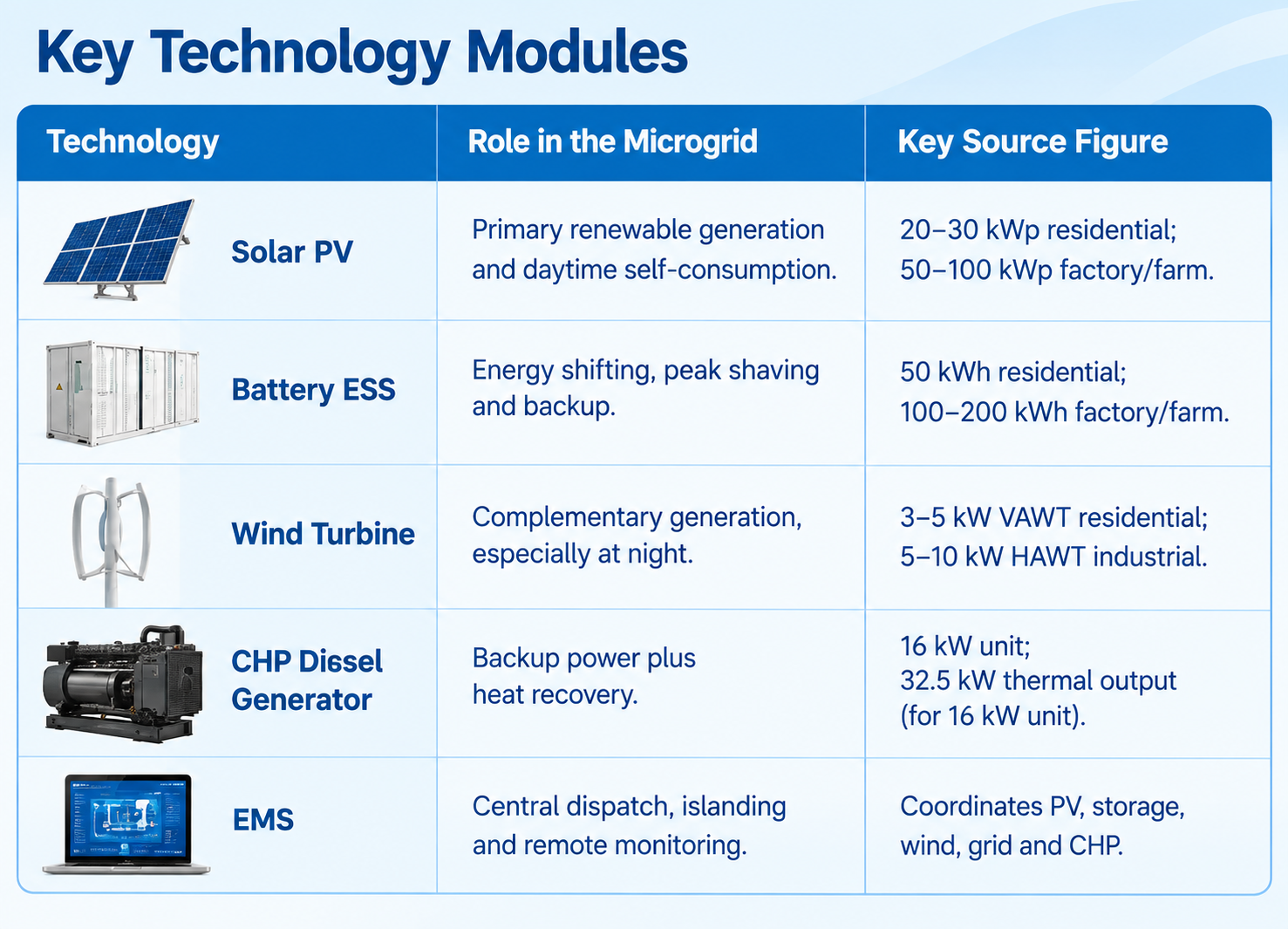
The operating strategy should be dynamic rather than a fixed source hierarchy. Renewable energy is used for local loads when available, storage shifts energy across time, lower-cost grid electricity can be used when beneficial, and CHP starts when reliability or thermal demand requires controllable generation.
|
Time / Condition |
Price / Condition |
EMS Strategy |
Main Objective |
|
00:00–08:00 |
Off-peak; €0.02–0.04/kWh |
Charge ESS with lower-cost grid electricity when appropriate; use available wind. |
Energy-cost optimization. |
|
08:00–10:00 |
Low-price; €0.04–0.08/kWh |
PV supplies local loads; ESS supports as needed; grid covers deficits. |
Maximize self-consumption. |
|
10:00–14:00 |
Peak; €0.20–0.35/kWh |
Discharge ESS; use PV locally; export only when economically appropriate. |
Peak shaving and value optimization. |
|
14:00–18:00 |
Low-price; €0.04–0.08/kWh |
Continue PV self-consumption and prepare ESS for the evening peak. |
Reduce grid purchases. |
|
18:00–22:00 |
Peak; €0.20–0.35/kWh |
Discharge ESS; start CHP only when renewable energy and storage cannot meet critical demand. |
Reliability with controlled fuel use. |
|
22:00–24:00 |
Low-price; €0.04–0.08/kWh |
Balance ESS state of charge, night wind and next-day requirements. |
Cost and resilience. |
|
Negative-price period |
Special condition; source example 11:00–16:00 |
Prioritize local consumption and ESS charging; avoid unnecessary export; curtail where necessary. |
Avoid negative-price losses. |
CHP changes the diesel generator from an emergency-only device into a controllable source of electricity and useful heat. Recovered heat can serve heating and domestic or process hot water, while hot-water storage separates heat production from heat demand. In off-grid applications, CHP can also reduce the battery capacity needed during prolonged low-renewable periods.
Factories and farms can combine rooftop or land-based PV, battery storage, wind, CHP and thermal storage to support continuous operation, night-time demand and heating loads.
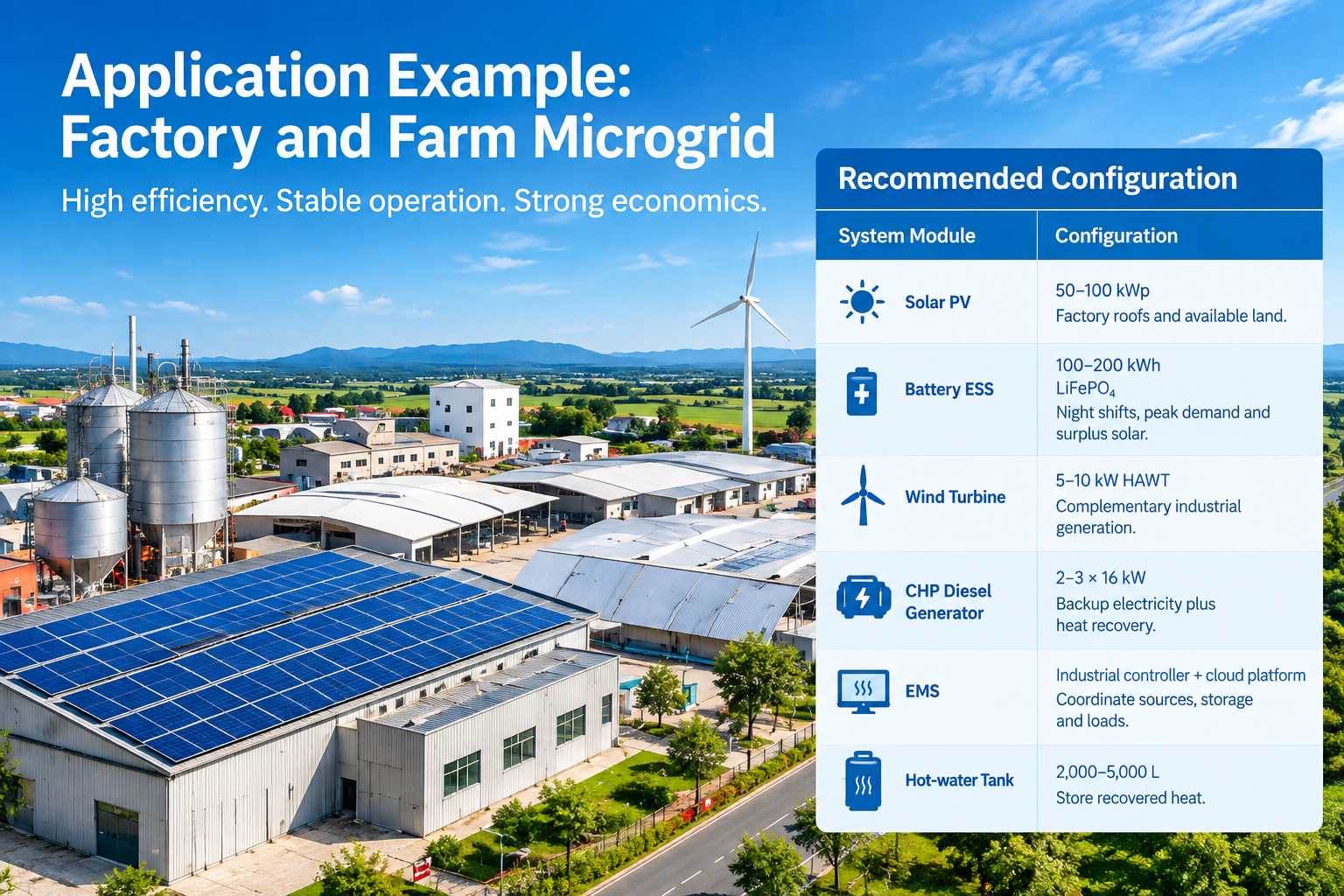
A representative payback estimate is around 3–5 years, but actual results depend on load profile, electricity prices, equipment costs, renewable yield and operating strategy.
For detached homes, villas and rural properties, the source solution proposes a smaller, low-noise configuration focused on self-consumption, backup power, heating and hot water.
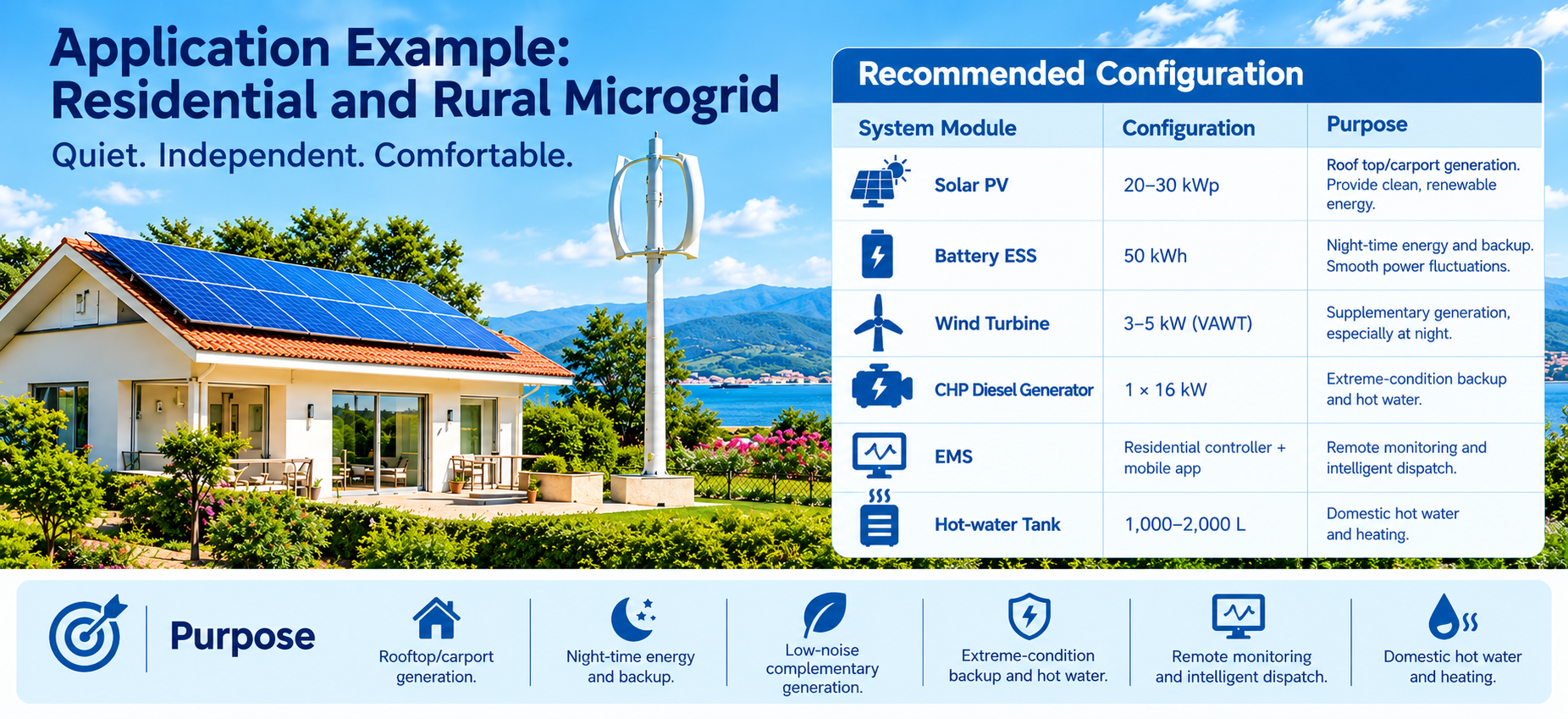
Final sizing should be based on actual household loads, seasonal renewable yield, battery autonomy and generator capacity. Complete off-grid independence should not be assumed without site-specific validation.
A successful microgrid requires engineering beyond an equipment list. The project should move from load assessment and customized design through compliance, production, installation, commissioning and long-term support.
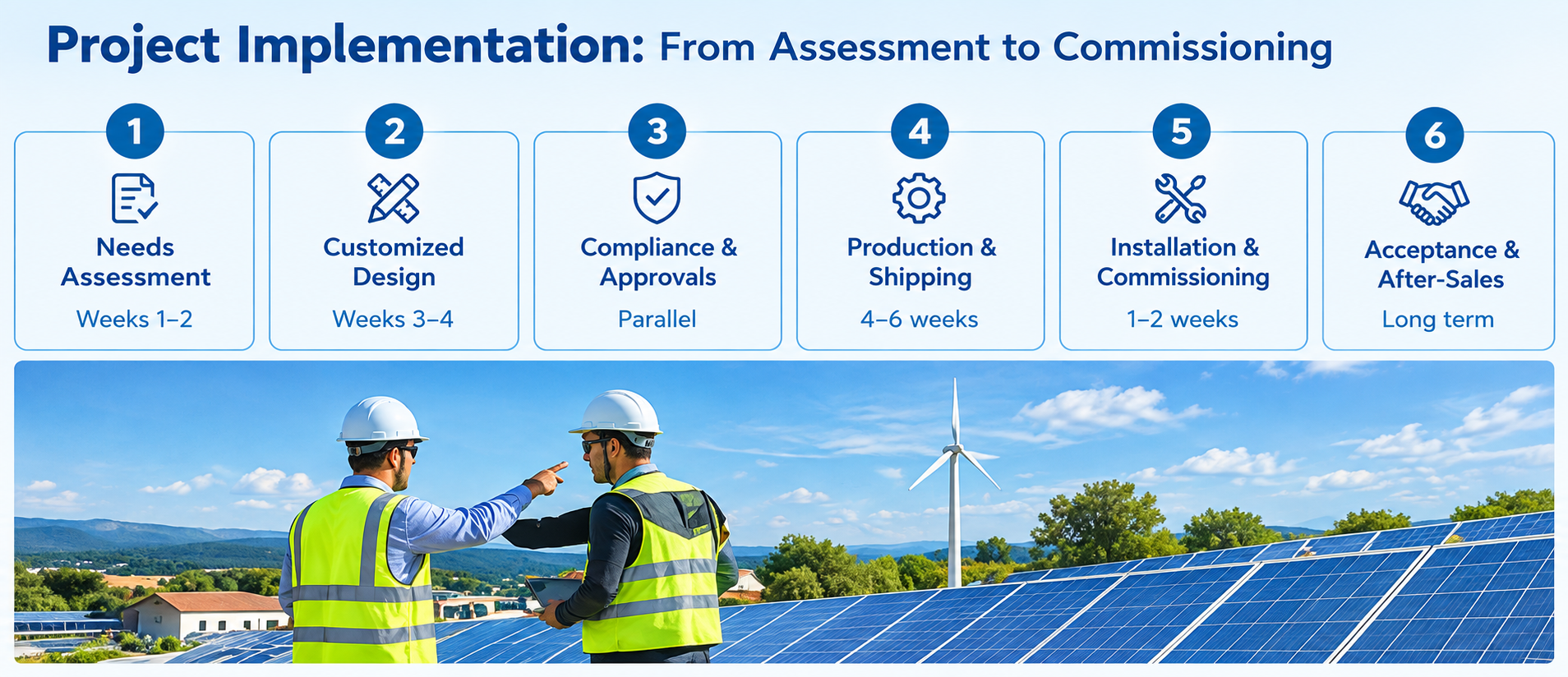
A microgrid should be designed around the interaction between energy production, consumption, electricity prices, thermal demand and reliability requirements. Solar can provide strong daytime generation, but it cannot by itself solve evening demand, grid outages or heating requirements. Wind can complement solar, but low average wind speeds limit its role. Battery storage shifts energy across time, while CHP provides controllable backup and useful heat.
The value of the system therefore comes from coordinated control rather than any single component. Final sizing should use real site data, including electrical load curves, critical loads, heating and hot-water demand, solar and wind resources, grid conditions, electricity tariffs and economic objectives.
Torchpower provides one-stop energy technology solutions covering system assessment, customized design, equipment supply, compliance support, delivery, remote technical guidance, commissioning coordination and long-term after-sales support. Each microgrid can be configured according to the site's load profile, available space, budget, renewable resources and grid conditions.