Industrial Generator Parallel System Solution
1. Industry Pain Points
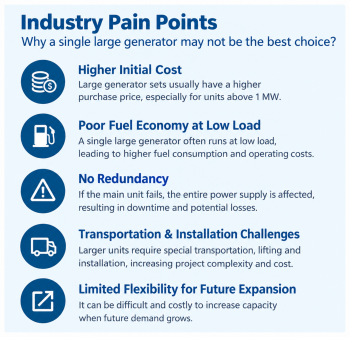
For projects requiring big generating capacity (such as 1 MW or more), the natural choice is often to specify one larger diesel generator. However, a larger individual generator is not necessarily the most economical or practical solution.
In many industrial applications, the project load changes throughout the day. A single oversized generator must still run to cover the required load, even when actual demand is much lower. This can lead to higher fuel consumption per unit of useful power and less efficient operation.
There is also a reliability and maintenance issue. With one large generator, a major fault or scheduled maintenance can remove the entire generating capacity from service. For critical applications, this creates a single point of failure.
Procurement and logistics can also become more complicated as generator size increases. A very large unit may require higher transportation capacity, larger lifting equipment, more installation space and more demanding site access conditions.
Another common misconception is that the largest generator automatically provides the best value. For high-power projects, the better question is whether one large unit or several smaller units can provide the required total capacity with lower lifecycle cost and greater operational flexibility.
This is why, particularly for applications above 1 MW, it is worth comparing a single large generator with a properly engineered multi-generator parallel system before making the final equipment selection.
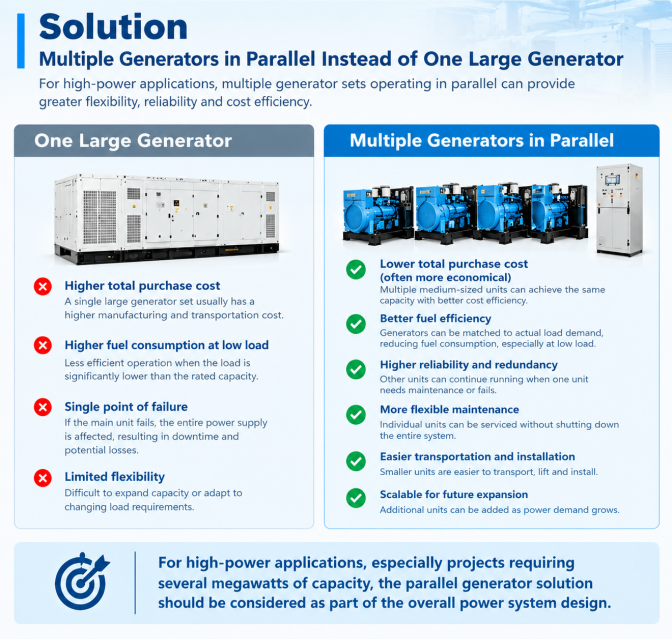
2. Solution: Multiple Generators in Parallel Instead of One Large Generator
The solution is not simply to replace one generator with several generators. The key is to design the generator capacity around the project's actual load profile and operating strategy.
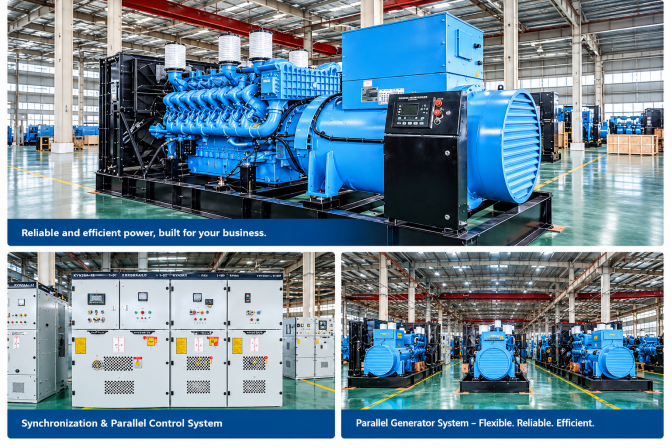
For a variable-load or high-reliability application, several generator sets can operate in parallel through a common bus. A synchronization and load-sharing system coordinates the units so that voltage, frequency and power output remain within the required operating range.
When the load is low, fewer generator sets can operate. As demand increases, additional units can automatically start, synchronize with the bus and share the load. This modular approach allows the generating capacity to follow the actual demand more closely.
A complete parallel solution should also include coordinated protection, circuit breakers, busbar design, monitoring and load management. The final configuration should be based on the project's load list, motor-starting requirements, voltage, frequency, short-circuit level, required redundancy and future expansion plan.
Why Compare the Two Architectures?
3. Configuration List & Project Example: 7.2 MW MTU Generator Parallel System
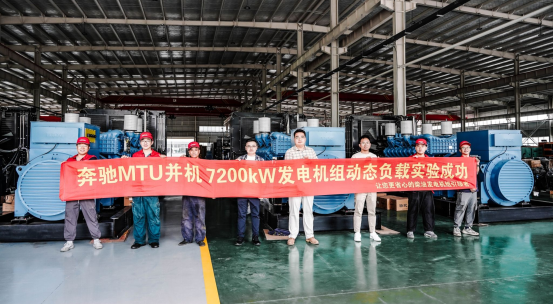
A practical example is a 7.2 MW high-power project using four MTU diesel generator sets operating in parallel.
The system consists of four 1,800 kW generator sets, providing a combined installed capacity of 7,200 kW. The units are integrated through a dedicated synchronization and paralleling system, allowing the generating capacity to be managed as one coordinated power system.
According to the site's load demand, different numbers of generator sets can be brought online. When higher capacity is required, additional units can synchronize to the common bus and share the load. The exact start/stop sequence and redundancy strategy should be determined from the project's load profile and operating requirements.
The project configuration demonstrates how a multi-generator architecture can provide a practical alternative to one very large generator when the total power requirement reaches several megawatts.
Recommended Configuration
|
Item
|
Recommended Configuration
|
|
Total installed capacity
|
7,200 kW
|
|
Generator sets
|
4 × 1,800 kW
|
|
Engine
|
MTU diesel engine
|
|
Operating mode
|
Automatic parallel operation
|
|
Synchronization
|
Automatic synchronization
|
|
Load sharing
|
Active and reactive power sharing
|
|
Paralleling switchgear
|
Common-bus paralleling switchgear
|
|
Generator breakers
|
One breaker per generator set
|
|
Protection
|
Overcurrent, short circuit, under/over-voltage, under/over-frequency, reverse power and project-specific protection
|
|
Monitoring
|
Voltage, current, frequency, kW, kVA, power factor, engine parameters and alarms
|
|
Cooling
|
Engine-mounted radiator cooling system
|
|
Fuel system
|
Fuel supply and return system
|
|
Exhaust system
|
Exhaust piping and silencer
|
|
Starting system
|
Electric starting batteries and battery chargers
|
|
Emergency stop
|
Local and system emergency-stop functions
|
|
Remote monitoring
|
Optional remote monitoring and communication
|
|
Load management
|
Optional load shedding / load management
|
Engineering note: The exact generator rating, switchgear rating, voltage level, busbar capacity, protection settings, cable sizing and load-management strategy should be confirmed from the project's electrical load list, voltage, frequency, short-circuit level, motor-starting requirements and operating philosophy.
Engineering Takeaway
The right generator solution is not necessarily the largest individual generator. For high-power applications, comparing a single large unit with a multi-generator parallel system can reveal significant differences in procurement cost, fuel economy, availability, maintenance flexibility and future scalability.
The objective is to select the architecture that delivers the required power with the best balance of investment, operating cost, reliability and flexibility.
 EN
EN